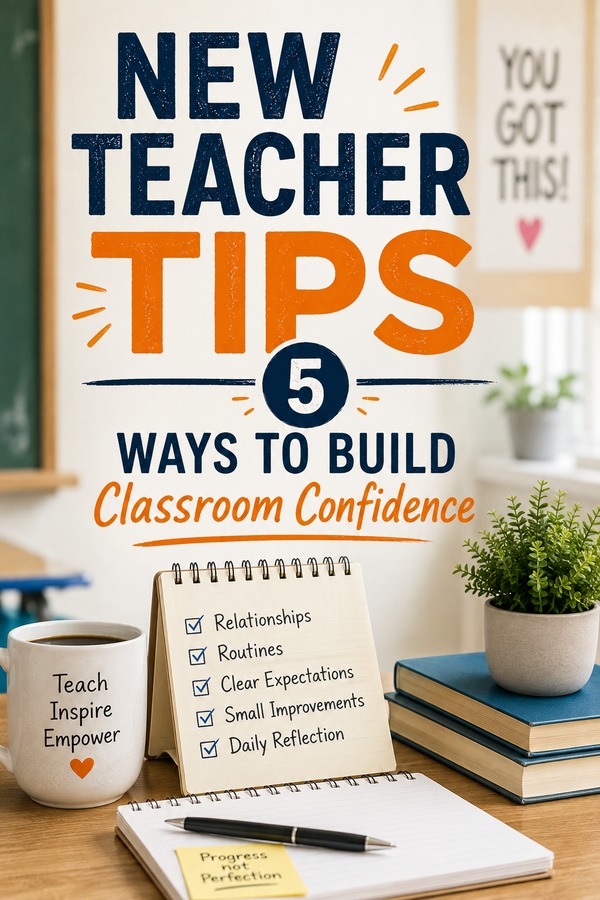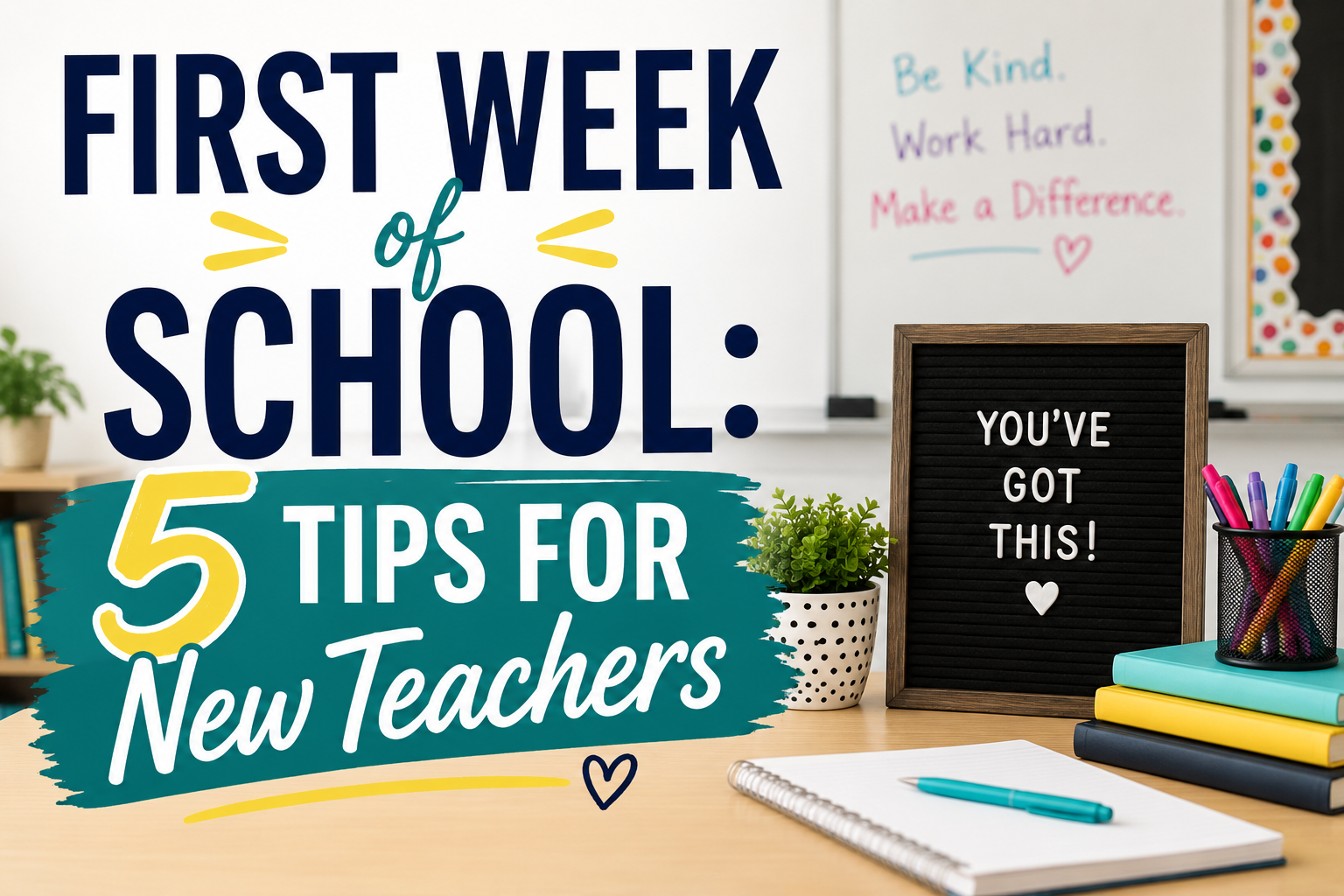

The first few weeks of school can make even the most prepared teacher wonder whether they’re doing enough. These new teacher tips can help you focus on what matters most, make practical adjustments, and build classroom confidence without trying to fix everything at once.
You planned your lessons. You organized your classroom. You thought through your procedures and expectations.
Then the students arrived.
Suddenly, transitions take longer than expected. Students need directions repeated. A lesson that looked great on paper doesn’t quite work the way you imagined. Papers start piling up, and you find yourself making dozens of decisions you never remember discussing in college.
Welcome to teaching.
The good news is that you don’t have to solve every problem at once. In fact, trying to do that usually creates more stress.
Instead, focus on a few small changes that can make your classroom easier to manage and help you become more confident each day.
Table of Contents
ToggleNew Teacher Tips: Start With the Biggest Source of Friction
When several things aren’t working, it’s tempting to change everything.
Don’t.
Identify the one classroom issue creating the most stress right now.
Maybe students aren’t settling down when class begins. Maybe transitions are eating up instructional time. Maybe you’re spending too many evenings grading. Or perhaps students aren’t following directions consistently.
Choose one problem and ask yourself:
What is one small change I can make this week that would make this easier?
Then work on that one thing.
Small improvements have a way of creating momentum. Once one routine begins working better, you can move on to the next.
2. Reteach Instead of Repeating
One of the most practical new teacher tips is to remember that procedures often need to be taught more than once. If a classroom procedure isn’t working, repeating the same reminder louder usually isn’t the answer. Stop, clarify what you expect, model it when necessary, and give students another opportunity to practice it.
If a classroom procedure isn’t working, simply saying it again—only louder—is usually not the answer.
Stop and reteach it.
Explain what you expect. Model it when necessary. Let students practice it again. Then reinforce the procedure consistently.
Remember, procedures don’t automatically become routines because you explained them once during the first week of school.
Students may need reminders and practice before a procedure becomes something they do automatically.
That isn’t necessarily a classroom management failure. It’s part of teaching.
3. Protect Your Time Before Grading Takes It Over
Here’s one of the most important new teacher tips I wish more teachers heard early in their careers:
Not everything students complete needs a grade.
New teachers can easily fall into the trap of believing every assignment must be graded and every task must be finished before they leave school.
It doesn’t.
Before grading something, ask:
Do I actually need to grade this to know whether my students are learning?
Some work deserves a grade. Other work can be checked for completion, discussed as a class, reviewed through peer feedback, or simply used as practice.
Being selective about what you grade isn’t lowering your standards. It allows you to spend your time on the work that provides meaningful evidence of student learning.
And it can help keep that stack of papers from following you home every night.
4. Don’t Confuse Experience With Perfection
It can be easy to look at the veteran teacher down the hallway and assume they’ve somehow figured everything out.
They haven’t.
Experienced teachers still have lessons that don’t work. They still encounter difficult behaviors. They still have days when the classroom doesn’t go according to plan.
The difference is experience.
Veteran teachers have encountered enough situations to recognize many problems earlier and have developed strategies for responding to them.
That takes time.
As a new teacher, you’re building that experience right now.
A difficult day isn’t necessarily evidence that you’re doing something wrong. Sometimes it’s simply information you can use to make tomorrow better.
Ask yourself:
What did today teach me about my students, my lesson, or my classroom routines?
That question turns frustration into something useful.
5. Use a Three-Question Daily Reflection
You don’t need another complicated system.
And you certainly don’t need another form to fill out.
At the end of the school day, take two minutes and ask yourself three questions:
What worked?
What didn’t?
What will I do differently tomorrow?
That’s it.
You might discover that a transition needs another minute. Your directions need to be shorter. A seating arrangement needs adjusting. Or perhaps something worked extremely well and you want to repeat it.
Teaching improves through hundreds of these small adjustments.
The goal isn’t to walk into your classroom already knowing everything.
The goal is to become a little better at reading your classroom and responding to what your students need.
New Teacher Tips Don’t Have to Be Complicated
Sometimes the best improvement isn’t another complicated strategy. It’s identifying one thing that isn’t working and making a thoughtful adjustment.
So if you’re feeling overwhelmed, don’t try to reinvent your entire classroom tomorrow.
Choose one thing.
Fix one procedure. Adjust one lesson. Protect one block of your time. Reflect on one part of your day.
Then build from there.
Confidence doesn’t usually arrive all at once. It develops as you collect small wins and begin realizing, I can handle this.
If you’re looking for more practical support as you build confidence in the classroom, explore my new teacher resources for strategies designed specifically for new and early-career teachers.
Practical Support for Your Teaching Journey
Over the years, I’ve written books designed to help teachers navigate the practical side of teaching—the situations that often become clearer only after you’ve spent time in your own classroom.
If you’re looking for additional new teacher tips, practical strategies, or encouragement, I’ve brought my books together on my Amazon Author Page. You can browse the available titles and choose the resource that best fits where you are in your teaching journey.
Explore Stephen Hiles’ books on Amazon:
https://www.amazon.com/stores/Stephen-Hiles/author/B006YZI2Q4
You don’t have to have everything figured out.
Keep learning. Keep adjusting. Keep moving forward.